August 7, 2026
Disclosure: I’m the original author and lead for the Bombadil project at Antithesis.
Carlos Catala, interning at Antithesis and working on testing our webapps, found a strange crash while I was out camping. The tests he works on runs Antithesis’ webapp inside Antithesis and explores it using Bombadil. That surfaced a particular sequence of events leading up to the following crash (logs are simplified for readability):
state machine error: unhandled transition: Running(10) + ActionAccepted(Click("Filters"))What does this mean? To understand it, we need to back up a little.
The heart of the browser driver is a finite state machine,
an abstract model of a tab in Chrome or Chromium, and how we’re
interacting with it over CDP. This is necessary due to how you can only
invoke certain commands in certain browser states, or it might hang or
behave in other confounding ways. In our state machine, some transitions
are valid, and those are handled in a big
match (state, event) { ... } expression that returns a new
state. Invalid transitions are covered by the last branch that returns
an Err with a message like the above.
There’s another important component involved which is called the runner. It decides the control flow of the test, and uses the driver to run the system under test. The driver emits a state, and the runner decides what action to take in that state. It hands back the action to the driver so that it can apply it. The browser driver actually pauses the JS runtime when capturing a state, and doesn’t resume execution until the driver has given back the next action.
Hence, the ActionAccepted event (which is when the
driver gets a new action from the runner) is not valid in the
Running state. It really is only valid in the
Paused state. How could this happen? The driver and runner
are supposed to operate in lock-step, where the driver is only in
control while the JS runtime is paused. This was the nut to crack.
When Carlos told me about this during my PTO, my camping brain was definitely not helpful, so I let it rest until I was back at work. Staring at logs and code also didn’t help much, except for a poorly conceived theory about what could be going on, mislead by the presence of network faults in one test where we saw the bug. We tried but failed to reproduce this locally, so I decided to find a simpler test subject and, crucially, try to reproduce it in Antithesis.
To reduce possible confusion I wanted to first see if I could trigger the same bug in Bombadil with a simpler system under test. I found a Dockerized version of the-internet, an example application by Sauce Labs made for automated browser testing. Based on what we had seen before, I wrote a very small specification that only performs three actions:
export * from "@antithesishq/bombadil/browser/defaults/properties";
import { weighted } from "@antithesishq/bombadil/browser";
import {
  back,
  forward,
  clicks,
} from "@antithesishq/bombadil/browser/defaults/actions";

export const navigation = weighted([
  [1, clicks],
  [1, back],
  [1, forward]
]);
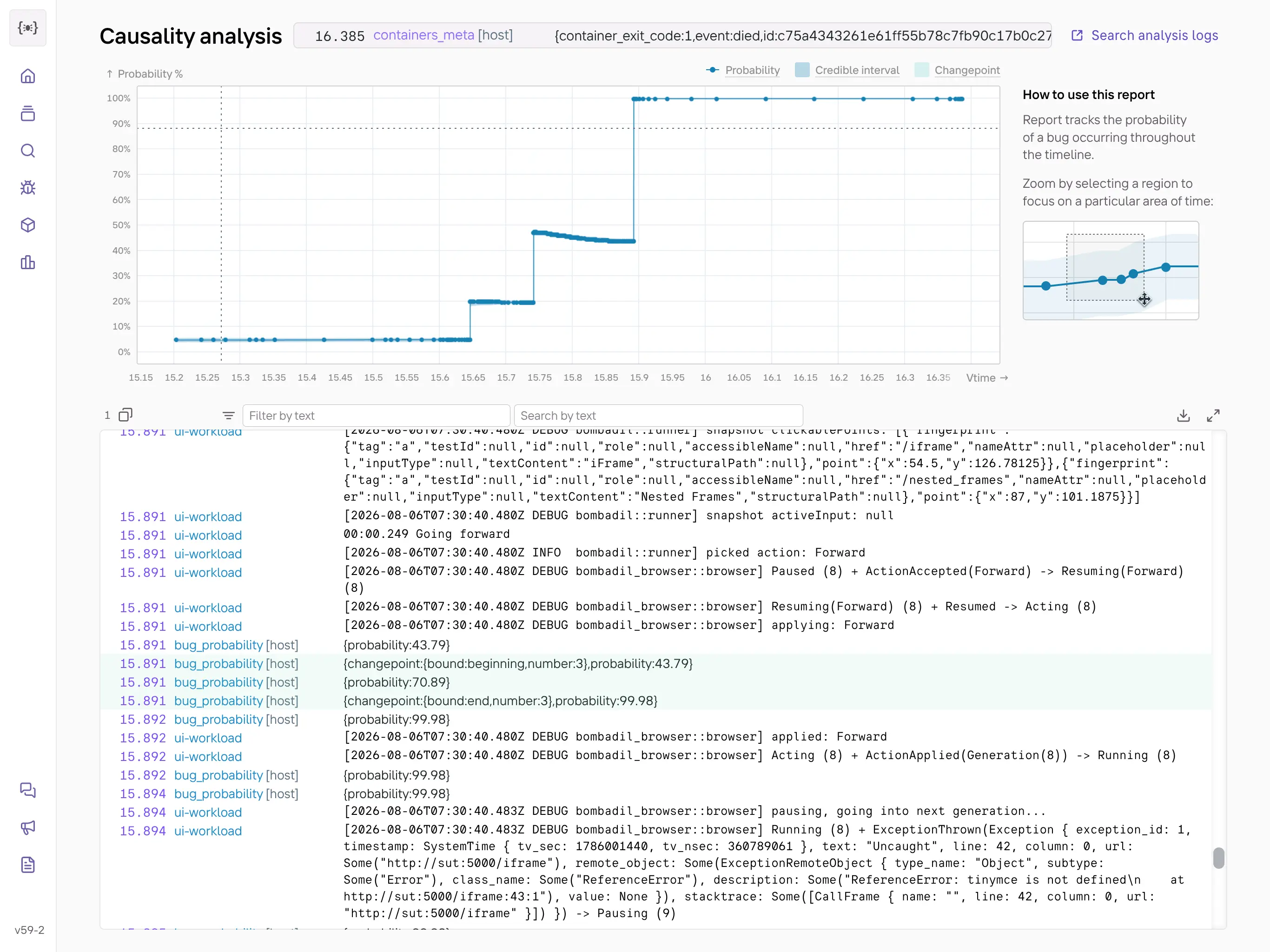
In addition to finding various bugs in the Ruby code, it also immediately reproduced the Bombadil bug! Time to dig in. I went through a few instances and started to see a pattern. In addition, this gave me an excellent opportunity to try out Causality Analysis, a mind-bending feature for learning what behavior increases the likelihood of a bug appearing. Here’s the report I got:
As you may see in the chart, there are three points where the probability increases markedly. Correlating those with the logs (which is easy, you see the bumps highlighted in the log too), I could find the chain leading up to the bug:
/frames (probability
goes to 20%)/iframe
(probability goes to 47%)After the last “Go forward” action, it’s a done deal. Digging into the details in between these points, I could then see how going back to a page which immediately throws an exception, after restoring from bfcache, takes a different path than most page loads do.
When going back or forward in history, the state machine immediately
transitions to Running, waiting for confirmation by the
browser to know what actually happened. Some pages prevent bfcache
through JavaScript or HTTP headers, so a history navigation can also end
up as a full page load with new HTTP requests. When the page is
confirmed to have been restored from bfcache, the page and thus the
state machine model skips the Loading state entirely, and
goes straight to Running.
In this case, that was followed by the exception being thrown
immediately (you can see it in the bottom of the screenshot above),
which triggers another path: exceptions thrown while in
Running aren’t collected and reported at a later state
capture, as is the case for the Loading state — they
immediately pause the runtime and trigger a new state read. This in turn
let the runner pick a new action to perform. But the CDP event that
confirms that the page was restored from bfcache hadn’t arrived yet.
This is a race between the asynchronous communication of runner and browser state machine, selecting the next action, and the CDP event sent by Chromium over a WebSocket confirming the bfcache restore. The unfortunate ordering that triggers the bug is:
RunningActionAccepted event, which,
as we noted in the beginning of this excursion, is not valid when in
RunningThis sequence causes the crash. It only happens with bfcache-enabled history navigation to a page with an exception being thrown before the confirmation from Chromium comes back. Antithesis’ deterministic fuzzing environment messes with process scheduling and action selection and discovers this sequence reliably.
I’m not going to describe the fix in too much detail, but it involves
a more robust use of the already existing Generation value
in the browser state machine. It’s a monotonically increasing number
that is used to detect stale timeouts and actions, so that the state
machine can discard them. The browser state now carries the current
generation, and that is threaded through the runner’s action selection
process, so that a stale action (as in step 5 above) can be safely
ignored. Additionally, some transitions now increment the generation in
cases where all existing timeouts or actions are stale.
I’ve had bugs of this kind before, and understanding them from staring at logs, let alone reproducing them, has been painful. This, in contrast, feels a bit like cheating. Moreover, it extends to race conditions and complicated bugs in the webapps themselves, which makes me very excited about continued work on the Bombadil and Antithesis integration.